
Far Eastern University
Strengthening Graduate Employability Through Industry Partnerships
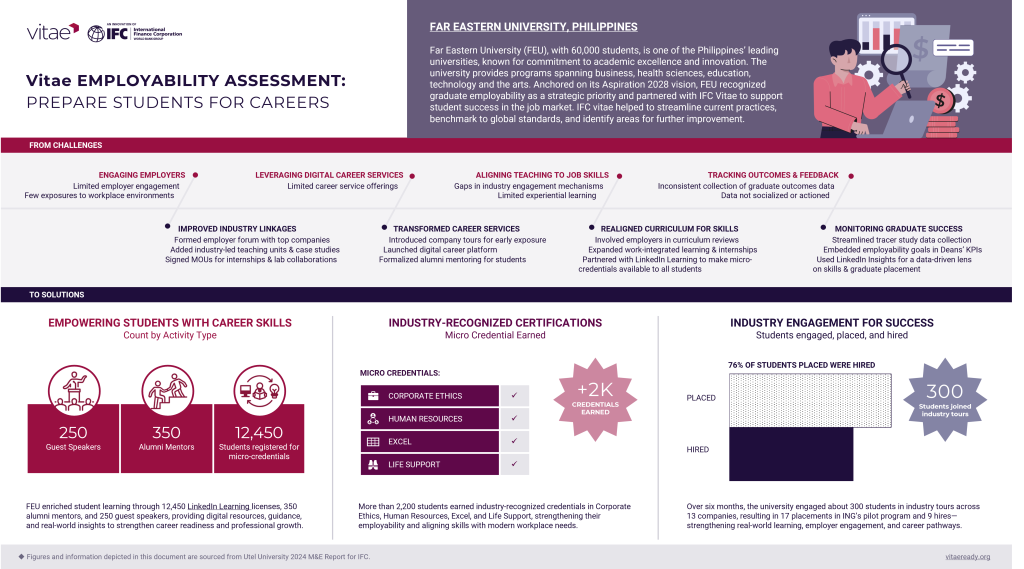
Far Eastern University (FEU), one of the Philippines’ largest and most established higher education institutions, partnered with Vitae to strengthen graduate employability and better align academic programs with evolving labor‑market needs. Through data‑driven benchmarking, expanded industry and alumni engagement, and the integration of industry‑recognized micro‑credentials earned by thousands of students, FEU transformed career services, embedded employability into institutional strategy, and created clearer pathways from education to employment.
This case study highlights how FEU leveraged Vitae tools and employer collaboration to move from fragmented efforts to a coordinated, outcomes‑focused employability strategy—delivering career‑relevant skills at scale, stronger industry linkages, and measurable improvements in graduate placement and hiring outcomes.
[Download the full Far Eastern University case study (PDF)]
For detailed data, methodology, and complete program insights.
Industry Voices from Far Eastern University
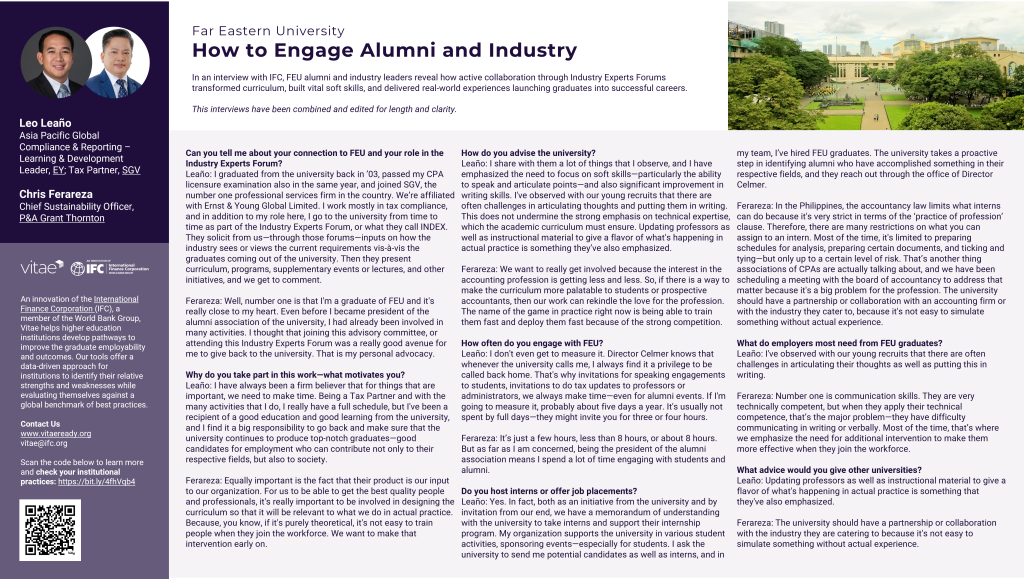
Alumni and industry leaders reflect on how sustained employer and alumni engagement through Far Eastern University’s Industry Experts Forum has strengthened curriculum relevance, enhanced workplace skills, and improved graduate employability outcomes. Conducted in collaboration with IFC, the discussion highlights how industry insight supports real‑world learning and helps bridge the transition from education to employment.
This interview features perspectives from Leo Leaño, Asia Pacific Global Compliance & Reporting – Learning & Development Leader at EY and Tax Partner at SGV, and Chris Ferareza, Chief Sustainability Officer at P&A Grant Thornton.
This interview has been edited for length and clarity. Selected insights from these industry leaders also feature in Vitae’s Industry Advisory Board learning module, which explores effective approaches to employer engagement in higher education.
Q. Can you tell me about your connection to FEU and your role in the Industry Experts Forum?
Leaño: I graduated from the university back in ’03, passed my CPA licensure examination also in the same year, and joined SGV, the number one professional services firm in the country. We’re affiliated with Ernst & Young Global Limited. I work mostly in tax compliance, and in addition to my role here, I go to the university from time to time as part of the Industry Experts Forum, or what they call INDEX. They solicit from us—through those forums—inputs on how the industry sees or views the current requirements vis‑à‑vis the graduates coming out of the university. Then they present curriculum, programs, supplementary events or lectures, and other initiatives, and we get to comment.
Ferareza: Well, number one is that I’m a graduate of FEU and it’s really close to my heart. Even before I became president of the alumni association of the university, I had already been involved in many activities. I thought that joining this advisory committee, or attending this Industry Experts Forum was a really good avenue for me to give back to the university. That is my personal advocacy.
Q. Why do you take part in this work—what motivates you?
Leaño: I have always been a firm believer that for things that are important, we need to make time. Being a Tax Partner and with the many activities that I do, I really have a full schedule, but I’ve been a recipient of a good education and good learning from the university, and I find it a big responsibility to go back and make sure that the university continues to produce top‑notch graduates—good candidates for employment who can contribute not only to their respective fields, but also to society.
Ferareza: Equally important is the fact that their product is our input to our organization. For us to be able to get the best quality people and professionals, it’s really important to be involved in designing the curriculum so that it will be relevant to what we do in actual practice. Because, you know, if it’s purely theoretical, it’s not easy to train people when they join the workforce. We want to make that intervention early on.
Q. How do you advise the university?
Leaño: I share with them a lot of things that I observe, and I have emphasized the need to focus on soft skills—particularly the ability to speak and articulate points—and also significant improvement in writing skills. I’ve observed with our young recruits that there are often challenges in articulating thoughts and putting them in writing. This does not undermine the strong emphasis on technical expertise, which the academic curriculum must ensure. Updating professors as well as instructional material to give a flavor of what’s happening in actual practice is something they’ve also emphasized.
Ferareza: We want to really get involved because the interest in the accounting profession is getting less and less. So, if there is a way to make the curriculum more palatable to students or prospective accountants, then our work can rekindle the love for the profession. The name of the game in practice right now is being able to train them fast and deploy them fast because of the strong competition.
Q. How often do you engage with FEU?
Leaño: I don’t even get to measure it. Director Celmer knows that whenever the university calls me, I always find it a privilege to be called back home. That’s why invitations for speaking engagements to students, invitations to do tax updates to professors or administrators, we always make time—even for alumni events. If I’m going to measure it, probably about five days a year. It’s usually not spent by full days—they might invite you for three or four hours.
Ferareza: It’s just a few hours, less than 8 hours, or about 8 hours. But as far as I am concerned, being the president of the alumni association means I spend a lot of time engaging with students and alumni.
Q. Do you host interns or offer job placements?
Leaño: Yes. In fact, both as an initiative from the university and by invitation from our end, we have a memorandum of understanding with the university to take interns and support their internship program. My organization supports the university in various student activities, sponsoring events—especially for students. I ask the university to send me potential candidates as well as interns, and in my team, I’ve hired FEU graduates. The university takes a proactive step in identifying alumni who have accomplished something in their respective fields, and they reach out through the office of Director Celmer.
Ferareza: In the Philippines, the accountancy law limits what interns can do because it’s very strict in terms of the ‘practice of profession’ clause. Therefore, there are many restrictions on what you can assign to an intern. Most of the time, it’s limited to preparing schedules for analysis, preparing certain documents, and ticking and tying—but only up to a certain level of risk. That’s another thing associations of CPAs are actually talking about, and we have been scheduling a meeting with the board of accountancy to address that matter because it’s a big problem for the profession. The university should have a partnership or collaboration with an accounting firm or with the industry they cater to, because it’s not easy to simulate something without actual experience.
Q. What do employers most need from FEU graduates?
Leaño: I’ve observed with our young recruits that there are often challenges in articulating their thoughts as well as putting this in writing.
Ferareza: Number one is communication skills. They are very technically competent, but when they apply their technical competence, that’s the major problem—they have difficulty communicating in writing or verbally. Most of the time, that’s where we emphasize the need for additional intervention to make them more effective when they join the workforce.
Q. What advice would you give other universities?
Leaño: Updating professors as well as instructional material to give a flavor of what’s happening in actual practice is something that they’ve also emphasized.
Ferareza: The university should have a partnership or collaboration with the industry they are catering to because it’s not easy to simulate something without actual experience.
Interested in how Vitae supports institutions like Far Eastern University?
Vitae offers a data‑driven approach for institutions to identify their relative strengths and weaknesses while evaluating themselves against a global benchmark of best practices.
